Aligners vs. Braces in Amstelveen: Which Is Right for You?
Are you considering orthodontic treatment in Amstelveen but unsure whether to choose traditional braces or clear aligners? It's one of the most common questions we hear at Dentinn. Both options straighten teeth effectively — but they work differently, feel different, and suit different lifestyles and dental needs. In this guide, we break down every key difference so you can make a confident choice.
Whether you're an adult professional who values discretion, a parent weighing options for your teenager, or simply someone who wants to understand the trade-offs before booking a consultation — this is your complete, unbiased comparison of aligners vs. braces in Amstelveen.
What Are Traditional Braces?
Traditional braces consist of metal or ceramic brackets bonded directly to the surface of each tooth, connected by a wire. Your orthodontist adjusts the wire every 4–8 weeks to apply controlled pressure that gradually moves teeth into the desired position. Braces are fixed — they remain on your teeth for the entire treatment duration and cannot be removed at home.
Braces are particularly effective for complex dental issues: severe crowding, significant overbites and underbites, rotated teeth, and intricate bite corrections. For the most demanding orthodontic cases, fixed braces remain the gold standard. Learn more about orthodontic treatment at Dentinn Amstelveen.
What Are Clear Aligners?
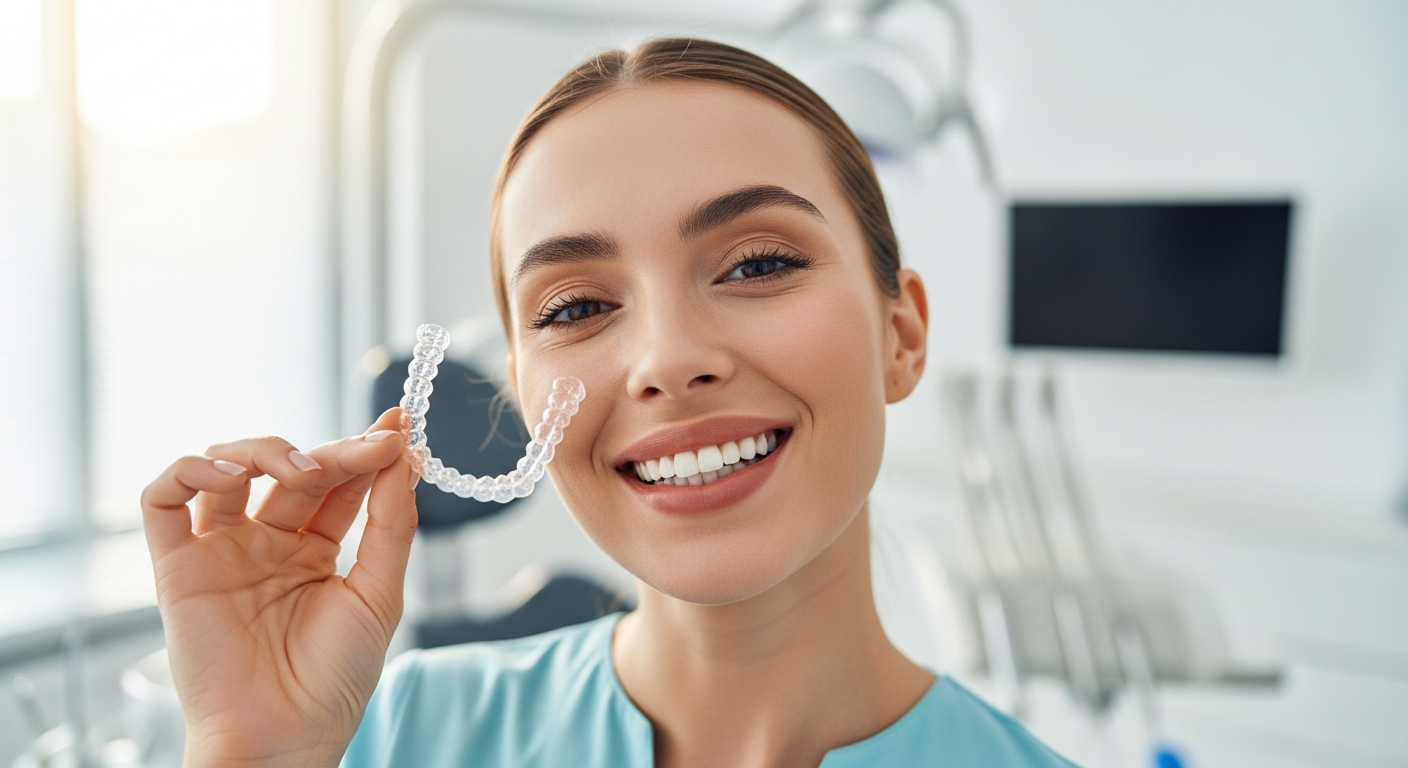
Clear aligners are a series of custom-made, transparent plastic trays that fit snugly over your teeth. Each tray applies gentle pressure to shift your teeth a fraction of a millimetre. After 1–2 weeks, you swap to the next tray in the series, progressively moving your teeth toward the desired position. The most widely used brand is Invisalign — available at Dentinn in Amstelveen.
Unlike braces, aligners are removable. You take them out to eat, drink, brush, and floss. For the treatment to work as planned, they must be worn for 20–22 hours per day. Consistency is essential.
Comfort and Daily Life Compared
Braces can cause soreness for 24–48 hours after each adjustment appointment. Brackets and wires may occasionally irritate the inside of the cheeks and lips — most patients adapt within a few weeks, but mild discomfort can persist throughout treatment. Certain foods (hard, sticky, or chewy) are off the menu for the duration.
Clear aligners are generally more comfortable. The smooth plastic trays have no sharp edges. Mild pressure is felt when switching to a new tray, but it typically eases within a day or two. You can eat anything you enjoy by simply removing the trays before meals — there are no food restrictions.
Appearance: Invisible vs. Visible
Metal braces are clearly visible when you smile or speak. Ceramic (tooth-coloured) braces are subtler but still noticeable up close. For adults in professional environments, or teenagers who are already self-conscious about their smile, the visibility of braces can be a significant concern.
Clear aligners are virtually invisible in everyday life. In meetings, on video calls, at social events — most people won't notice you're in treatment at all. For adult patients in Amstelveen and Amsterdam, this is often the single most important factor in their decision.
Effectiveness: What Each Treatment Can Address
Both treatments can produce excellent results, but they are not equally suited to every case.
Braces excel at treating:
- Severe crowding: significantly overlapping teeth
- Major bite issues: large overbite, underbite, or crossbite
- Complex rotations: teeth that need significant turning
- Vertical movements: intrusion and extrusion of teeth
Modern clear aligners like Invisalign have advanced significantly and can now treat many moderate-to-complex cases effectively:
- Mild to moderate crowding — the most common presentation in adult patients
- Spacing and gaps between teeth
- Mild bite corrections: modest overbite, open bite, or midline discrepancies
- Relapse treatment: teeth that have shifted after a previous course of orthodontic treatment
Only the most complex cases still require fixed braces exclusively. A proper assessment during a consultation at Dentinn will determine which option is clinically appropriate for you.
Treatment Duration
Duration depends on the complexity of your case rather than which system you choose. As a general guide for orthodontic patients in Amstelveen:
- Traditional braces: 12–30 months
- Invisalign Full: 12–24 months for most cases
- Invisalign Lite (mild cases, fewer aligners): 3–9 months
One key difference: aligner treatment duration depends on compliance. Braces move teeth continuously because they're bonded to the tooth surface. Aligners only work when they're in your mouth. Patients who wear their trays consistently see results on schedule — those who remove them too frequently may find treatment takes longer than planned.
Cost Comparison in the Netherlands
In the Netherlands, orthodontic treatment for adults is not covered by standard health insurance (basisverzekering). Some supplementary insurance plans (aanvullende verzekering) offer partial reimbursement, particularly for patients under 18. Typical costs in the Amstelveen area:
- Metal braces: €2,000–€3,500
- Ceramic braces: €2,500–€4,000
- Invisalign Full (moderate to complex cases): €2,500–€5,000
- Invisalign Lite (mild cases): €1,800–€2,800
The cost difference between braces and aligners is often smaller than patients expect — especially for mild and moderate cases where both options are clinically viable. During your consultation at Dentinn Amstelveen, you will receive a clear, itemised quote with no hidden fees.
Which Is Better: Adults vs. Teenagers?
Adults tend to strongly prefer clear aligners. The invisible appearance, the ability to remove them for presentations or important events, and the comfort advantage make aligners the natural choice for working professionals. Adults also show consistently better compliance — they've invested in the treatment and understand the importance of wearing trays faithfully.
Teenagers can succeed with both options. Fixed braces eliminate the compliance variable entirely, which is one reason they're often recommended for younger patients with complex cases. However, Invisalign Teen is a dedicated system designed for adolescent orthodontics, and includes built-in compliance indicators and replacement aligners. Motivated teenagers who commit to wearing their trays consistently are excellent candidates for aligner treatment.
Common Patient Misconceptions
At Dentinn in Amstelveen, we regularly hear the same misunderstandings about orthodontic treatment. Here are the most important ones to address:
"Aligners don't work as well as braces." This was true of early aligner systems in the late 1990s. Modern Invisalign technology treats the great majority of adult orthodontic cases effectively — including many that were previously considered aligner-ineligible.
"Clear aligners are much more expensive." For mild and moderate cases, the costs are broadly comparable. The difference is most pronounced for the most complex cases.
"Orthodontic treatment is only for teenagers." Adults account for a growing share of orthodontic patients across the Netherlands. Healthy teeth and gums respond to orthodontic forces at any age.
"I can use my old retainer to fix the relapse." A retainer is designed to hold teeth in position — not move them. If your teeth have shifted noticeably since your last treatment, a new course of active orthodontic treatment is required.
"Aligners are painful." Mild pressure when switching to a new tray is normal. The vast majority of patients find aligners considerably more comfortable than fixed braces.
Invisalign at Dentinn Amstelveen
At Dentinn, we offer Invisalign — the world's most clinically documented clear aligner system, with over 14 million patients treated globally. Treatment starts with a 3D digital scan of your teeth — no messy physical impressions needed. A personalised digital treatment plan is created, including a before-and-after simulation so you can visualise your expected result before committing.
Our Invisalign specialist Dr. Aydan Gündoğdu guides every aligner patient from first scan to final retainer. For complex orthodontic cases, our orthodontist Dr. Arzu Erdoğan Kekül brings specialist expertise to achieve the best possible outcome — whether with fixed braces or a combined approach.
We welcome patients from Amstelveen, Amsterdam, Diemen, Aalsmeer, and surrounding areas. Appointments are available in Dutch, English, and Turkish.
Invisalign at Dentinn — From €2,200
Book a consultation and receive a personalised 3D treatment plan. Flexible payment options available.
View Our Invisalign Offer →Frequently Asked Questions: Aligners vs. Braces in Amstelveen
In some cases yes — particularly if braces were used for the initial complex corrections and aligners are used to complete the final detailing. This is assessed case by case by your treating orthodontist.
📍 Dentinn Dental Clinic — Biesbosch 217, 1181 JC Amstelveen. Multilingual care in Dutch, English, and Turkish. Easily accessible from Amsterdam, Diemen, and Aalsmeer with free on-site parking. Book your orthodontic consultation today.