
Your First Dentist Visit in Amstelveen: A Step-by-Step Guide
Walking into a dental clinic for the first time — whether you are new to the Netherlands or simply haven't been in a while — can feel daunting. The sounds, the smells, not knowing what to expect: these are all completely normal feelings. The good news is that a first appointment is far more relaxed than most people imagine.
This guide walks you through everything that happens at a first dentist visit in Amstelveen, from arrival to the moment you leave — so you can walk in informed and at ease.
Step 1: Arrival and Check-In
When you arrive at the clinic, you will be welcomed by the reception team. At Dentinn Amstelveen, we greet you in the language you are most comfortable with — Dutch, English, or Turkish.
You may be asked to fill in a short health questionnaire if you are a new patient. This covers your general health, any medications you take, and whether you have any specific concerns about your teeth. It takes just a few minutes and helps your dentist understand your full picture before the examination begins.
Step 2: The Consultation
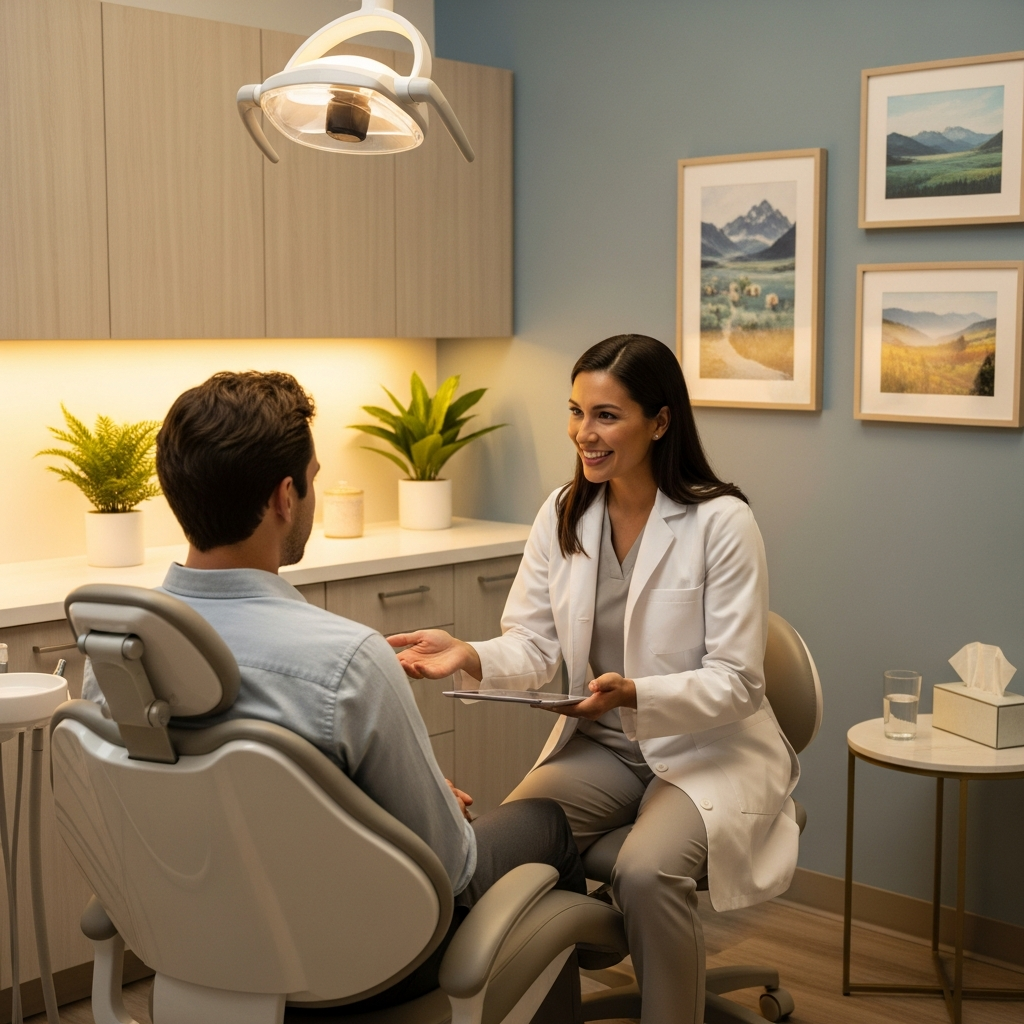
Once you are seated with your dentist, the appointment begins with a short conversation. Your dentist will ask:
- What brings you in today? — whether it is a routine checkup, a specific concern, or simply getting registered as a new patient
- How are you finding dental care generally? — including any past experiences that may have caused anxiety
- Your dental history — previous treatments, any ongoing sensitivity, habits like grinding or clenching
This is also the moment to share any worries. Our team at Dentinn has worked with many patients who feel nervous at the dentist — it is never unusual, and never judged. Mentioning your anxiety allows us to adapt the pace and explain each step before we do it.
Step 3: The Oral Examination
The examination itself is gentle and thorough. Your dentist will:
- Check each tooth individually — looking for signs of decay, cracks, worn enamel, or existing restorations that may need attention
- Examine your gums — checking for redness, recession, or pocketing that could indicate early gum disease
- Assess your bite and jaw — noting any alignment issues or signs of grinding
- Look at the soft tissues — tongue, cheeks, and the roof of the mouth are briefly checked as part of a standard oral health assessment
The whole examination typically takes 10–15 minutes. You will not feel pain during this step — it is purely visual and uses a small mirror and probe.
Step 4: X-Rays (If Needed)
For a first visit, your dentist will usually recommend a set of bitewing X-rays. These small images show the spaces between teeth and the bone levels underneath — areas that cannot be seen with the naked eye.
X-rays at a modern practice like Dentinn use digital radiography, which delivers a very low radiation dose (comparable to a short flight) and produces images instantly. They are an important diagnostic tool and help your dentist catch problems early, when they are simplest to treat.
If you have recent X-rays from a previous dentist, bring them along — we may not need to take new ones.
Step 5: Findings and Treatment Plan
After the examination, your dentist will sit down with you and explain what they found — in plain language, not medical jargon. If everything is healthy, that's wonderful news. If there are issues, your dentist will:
- Explain exactly what was found and why it needs attention
- Walk through the treatment options available
- Provide a written cost estimate before any treatment is agreed
- Let you decide how you want to proceed — nothing is done without your consent
There is no pressure. If you need time to think, ask questions, or get a second opinion, that is always respected.
Addressing Common Fears
Dental anxiety is more common than you might think — studies suggest that up to 1 in 3 people feel some level of nervousness before a dental appointment. Here is how we address the most frequent concerns:
- Fear of pain — modern dentistry has come a long way. Local anaesthesia is highly effective, and we always wait until you are fully numb before starting any procedure. You can raise your hand at any point to pause.
- Fear of judgment — whatever the state of your teeth, you will not be lectured or made to feel embarrassed. Our role is to help, not to criticise.
- Fear of the unknown — we narrate every step as we go. If you want to know what is happening, just ask. Knowledge reduces anxiety.
- Sensitive gag reflex — let us know beforehand. We have several techniques to make examinations more comfortable for people with a sensitive reflex.
- Bad past experiences — these are taken seriously. Tell us about them so we can approach your care differently from what you may have experienced elsewhere.
How to Prepare for Your First Visit
A few simple steps can make your first appointment go more smoothly:
- Brush and floss before you come — there is no need to do anything special, but arriving with clean teeth is a small courtesy
- Write down any questions — it is easy to forget them once you are in the chair
- Bring your insurance details — your health insurer name and policy number help the reception process your claim
- Arrive a few minutes early — especially if you are new and need to complete a health form
- Tell us if you are anxious — a short note when booking, or mentioning it on arrival, allows us to prepare a calm, unhurried approach
What Happens After the Visit
Once your appointment is complete, you will receive a clear summary of what was found and what — if anything — is recommended next.
- If no treatment is needed — your dentist will recommend a recall interval (usually six months) and book your next checkup
- If treatment is needed — you will receive a written treatment plan with itemised costs. You can book follow-up appointments at reception, at your own pace
- Hygiene appointment — if tartar or plaque buildup was noted, a separate appointment with our dental hygienist may be recommended. This is a routine cleaning, not a treatment
- Referral — if specialist care is needed (orthodontics, oral surgery, etc.), your dentist will provide a referral and explain the next steps
You are always welcome to call or email the clinic if questions come up after you leave. At Dentinn, we believe good dental care is built on clear communication — before, during, and after every visit.
Frequently Asked Questions
A first appointment at Dentinn typically takes 30–45 minutes, including the health questionnaire, consultation, oral examination, and X-rays if needed. If there are straightforward findings to discuss, this may extend slightly.
Ready to Book Your First Appointment?
Taking that first step is the hardest part — and once you are in the chair, most patients are pleasantly surprised by how straightforward and comfortable the experience is.
At Dentinn Amstelveen, we take pride in creating a calm, transparent, and patient-centred environment. Whether it is your very first dental appointment ever, or your first in a new country, we will make sure you feel informed and comfortable at every stage.
Book Your First Appointment at Dentinn
New patients of all ages are welcome. We offer appointments in Dutch, English, and Turkish — at our clinic at Biesbosch 217, Amstelveen.
Book an Appointment →📍 Dentinn Dental Clinic — Biesbosch 217, 1181 JC Amstelveen. Affordable public parking in front of the clinic. Tram and bus stop 2 minutes away. Easily reached from Amsterdam, Diemen, Aalsmeer, and Uithoorn.